iPASS’s iBS blockchain: How it ensures immutability and public consultation
By Marta Escabias

In the current context of digital transformation and sustainability, the European Union has taken a decisive step with the creation of the Digital Product Passport (DPP). This mechanism will require certain sectors—textiles, electronics, batteries, and construction materials—to have a verifiable digital record that accompanies each product from its design to its end of life.
The key to the DPP is trust in the data. How can we ensure that the information recorded about a product cannot be manipulated? How can we guarantee that this information is available to consumers, businesses, and authorities, without depending on a single intermediary?
The answer lies in blockchain technology, and particularly in iBS, iCommunity’s blockchain platform for enabling iPASS, our digital passport system. In this article, we will explore how iBS works and why it is essential to ensure the immutability and public consultation of DPP information.
The importance of immutability in the DPP
The value of the Digital Product Passport depends on the data being truthful and unalterable. If the information could be manipulated, the system would lose its purpose: traceability would become a mere formality without real guarantees.
Immutability ensures that once a piece of data—for example, the origin of a textile material or the carbon footprint of a battery—is recorded in the digital passport, no one can modify or delete it.
This principle is key for:
- Consumers, who need to trust the transparency of information.
- Companies, which compete in sustainability and reputation.
- Regulators, who must monitor compliance with European regulations.
This is where blockchain, and in particular iBS, comes into play.
What is iBS?
iBS, the blockchain platform developed by iCommunity, is the technological backbone that supports iPASS. Designed specifically to offer traceability, transparency, and immutability of data, iBS allows all information generated throughout the life cycle of a product to be securely recorded: from its manufacture to its recycling.
Thanks to its hybrid and scalable architecture, it combines the security and decentralization of blockchain with the efficiency needed to easily integrate into business processes. This ensures that each verification, certificate, or credential registered by iPASS is protected against manipulation, providing maximum confidence to both consumers and regulatory authorities. Its objective is to ensure that each credential registered in the DPP has:
- Immutability: data cannot be altered once registered.
- Traceability: every action on the product is reflected in an auditable history.
- Public consultation: any interested party can verify the information without the need for intermediaries.
How immutability works in iBS
The principle of immutability in iBS is guaranteed through a process of hashing and distributed registration.
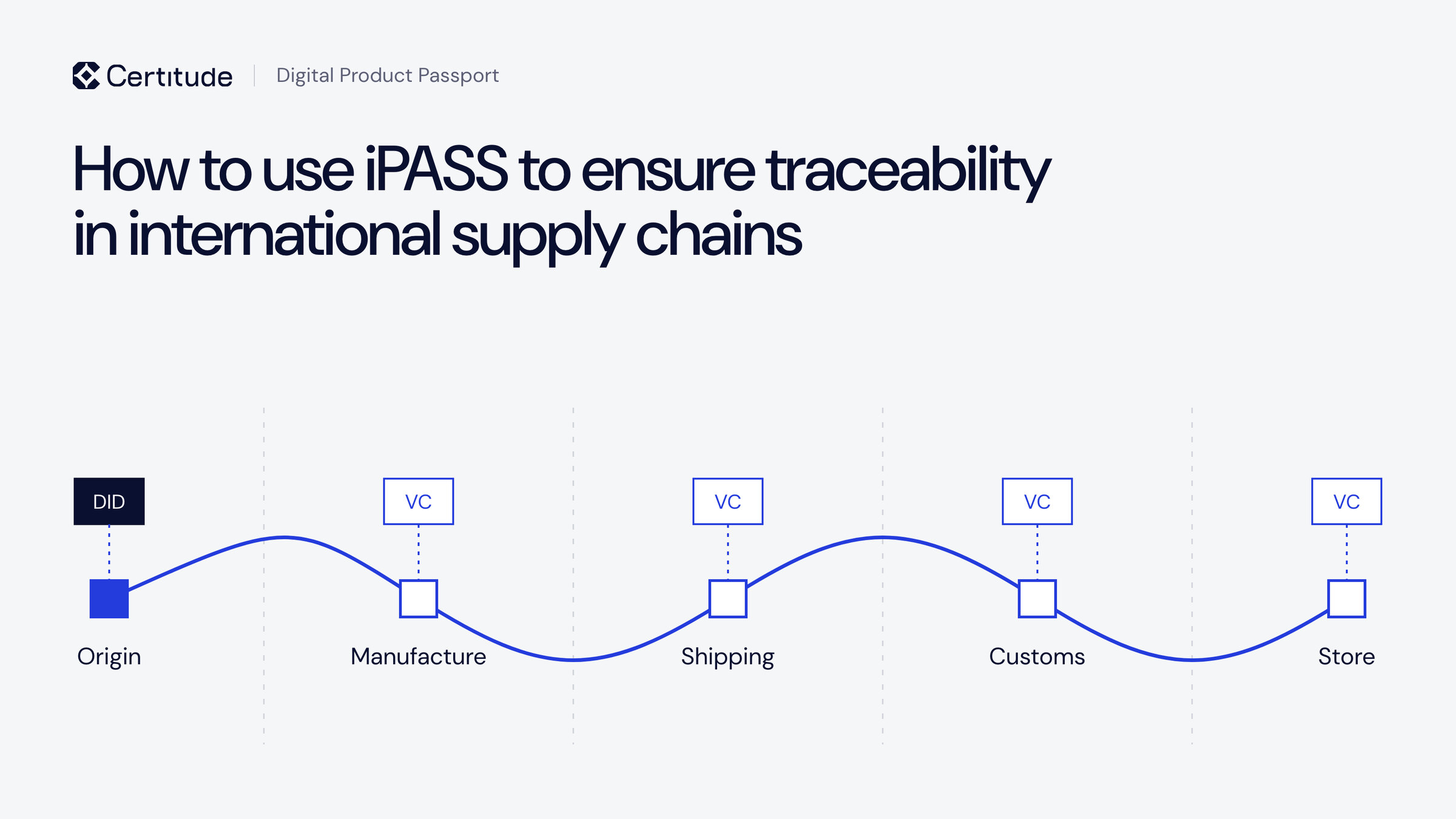
- Each time a Verifiable Credential (VC) is generated in iPASS (e.g., certification that a battery was recycled), a cryptographic hash is created that represents that data.
- That hash is stored in the blockchain, along with key metadata (date, issuer, product identifier).
- Once registered, that block is linked to the previous ones, forming an unalterable chain.
- Any attempt to manipulate the data would generate a different hash, which would be immediately detectable.
In this way, iBS turns each product milestone into a tamper-proof digital proof.
Public consultation: Transparency for all
One of the great values of iBS is that it allows public consultation of the registered information. This means that:
- A consumer can scan a QR code on a textile garment and verify that the information on recycled fibers is backed by a blockchain record.
- A distributor can verify that a battery has undergone a certified recycling process.
- A regulatory authority can audit compliance with regulations in construction materials without relying on information provided by the company itself.
Public consultation turns the DPP into a shared trust tool, where all actors have access to the same verifiable data.
Applications in priority sectors
Let’s see how the combination of iPASS and iBS adds value in the sectors where the DPP will be mandatory from 2026:
Textiles and footwear
Each garment can have a verifiable digital history: origin of fibers, production processes, associated emissions, and recycling options. Thanks to iBS, this data cannot be manipulated and is accessible to the consumer.
Electronics
Electronic devices carry information about critical minerals, energy consumption, and repairs. With iBS, distributors and users can trust that this information is authentic.
Batteries
The traceability of industrial and electric vehicle batteries is critical for the energy transition. iBS ensures that every piece of data on raw materials, carbon footprint, or recycling is immutable and verifiable.
Construction materials
Cement, steel, or insulation will be able to have digital passports that reflect energy efficiency and emissions. Thanks to iBS, developers and regulators will have reliable digital evidence.
Benefits of the iBS approach
The use of the iBS blockchain platform in iPASS provides significant advantages over other centralized systems:
- Trust without intermediaries: it is not necessary to depend on a single entity to validate the data.
- Fraud reduction: immutability makes it difficult to falsify or manipulate certifications.
- Total transparency: all actors have access to the same verifiable information.
- Regulatory compliance: facilitates audits and supervision by authorities.
- Sectoral scalability: can be applied to multiple industries with common needs.
The Future: Towards an economy of trust
iBS not only guarantees immutability and public consultation, it also lays the foundation for a new economic model based on digital trust. In the near future, we will see how:
- Consumers will be able to verify the authenticity of any product from their smartphone.
- Distributors will have tools to ensure that products meet sustainability standards.
- Regulators will have access to verifiable data in real time, simplifying audits and reducing bureaucracy.
- Companies will differentiate their products not only by quality or price, but also by transparency and digital responsibility.
Both the iBS platform and iPASS demonstrate how blockchain technology can be applied beyond cryptocurrencies, solving real problems of traceability, authenticity, and transparency in the industry.
Thanks to the immutability and public consultation offered by iBS, the Digital Product Passport becomes a reliable tool for companies, consumers, and regulators.
The future of the DPP relies on infrastructures like iBS, which transform information into digital trust and enable progress towards a more sustainable, circular, and transparent economy.