Globalization has created increasingly complex supply chains that cross continents and involve multiple actors: from miners and farmers to manufacturers, distributors, and recyclers. This complexity creates opportunities, but also risks: opacity, fraud, labor exploitation, and lack of environmental control.
The Digital Product Passport (DPP), which the European Union will make mandatory starting in 2026 in key sectors such as textiles, electronics, batteries, and construction materials, seeks to bring transparency and traceability to this global network.
To realize this vision, we at iCommunity have developed iPASS, a technological solution that turns the principles of the DPP into reliable, immutable, and accessible digital processes. In this article, we will see how iPASS ensures traceability in international supply chains and why it is a critical tool for businesses, consumers, and regulators.
The challenge of global traceability
Current supply chains face significant challenges:
- Lack of transparency: information is lost between multiple intermediaries.
- Risk of greenwashing: brands declare sustainability without verifiable evidence.
- Fraud and counterfeiting: products of dubious origin enter the market without effective controls.
- Hidden environmental impact: the carbon footprint or resource use is not adequately documented.
- Labor conditions: in many cases, consumers do not know if a product was manufactured respecting human rights.
The DPP addresses these challenges by requiring each product to have a verifiable digital history, accessible via a QR/URL. But, to function, it needs a solid technological infrastructure. That’s where iPASS comes in.
How iPASS ensures international traceability
The differential value of iPASS lies in combining international standards, blockchain, and verifiable credentials, ensuring that information flows reliably throughout the supply chain.
1. Unique Digital Identifiers (DID)
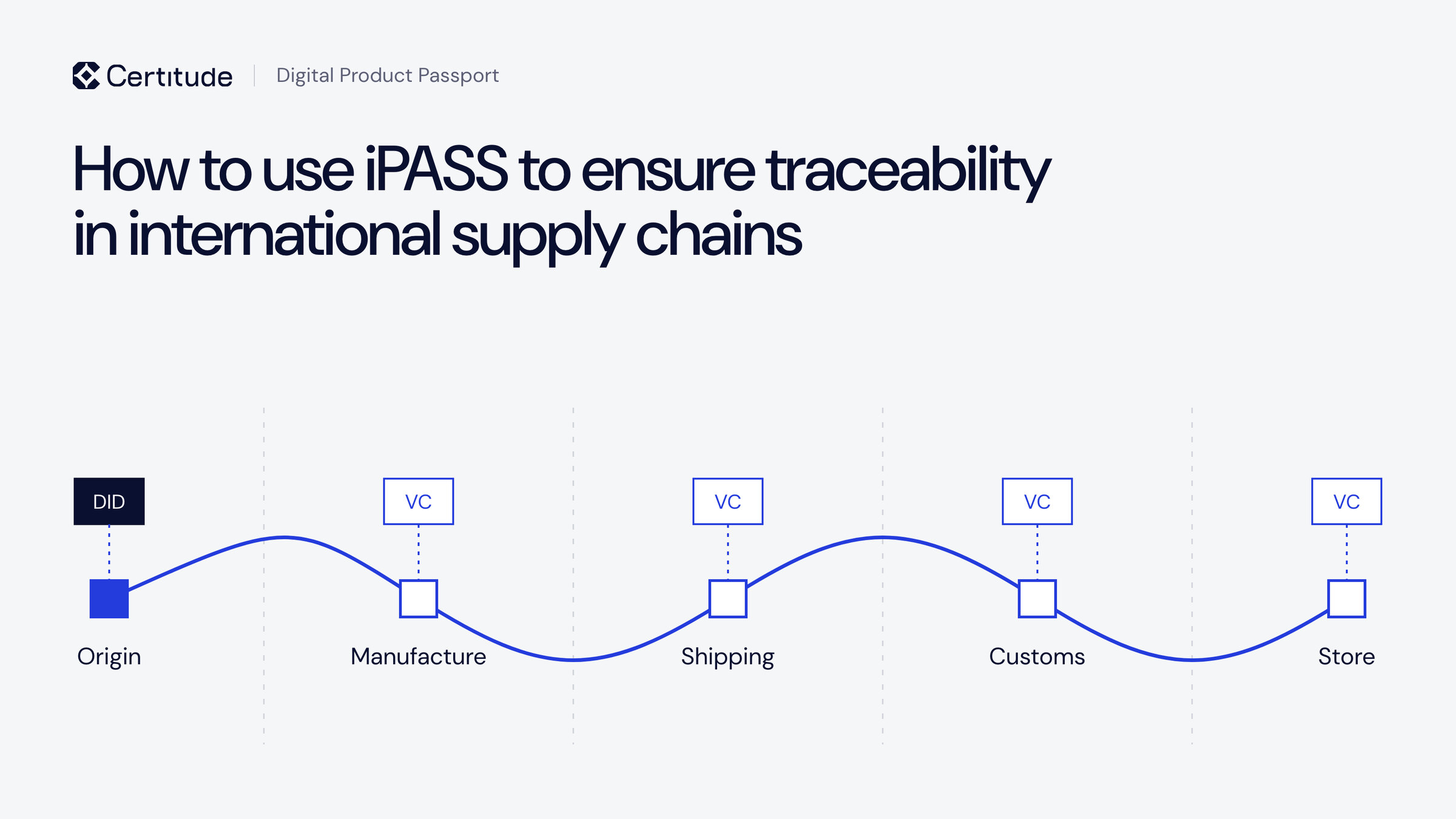
Each product has a Decentralized Digital Identifier, which accompanies it from origin to the end of its useful life. This avoids duplication and ensures authenticity in an international context.
2. Verifiable Credentials (VC)
Each actor in the chain (supplier, manufacturer, carrier, recycler) issues a VC that certifies their part of the process. These credentials are standardized and recognized throughout the EU.
3. iBS Blockchain Platform
All data is recorded on blockchain thanks to the iBS platform, which guarantees immutability and public consultation. Thus, a consumer in Paris, an auditor in Berlin, or a regulator in Brussels accesses the same verifiable information.
4. Universal access via QR/URL
The technological complexity translates into a simple interface: anyone can scan a QR code or open a link to see the complete product history.
Sectoral use cases in international chains
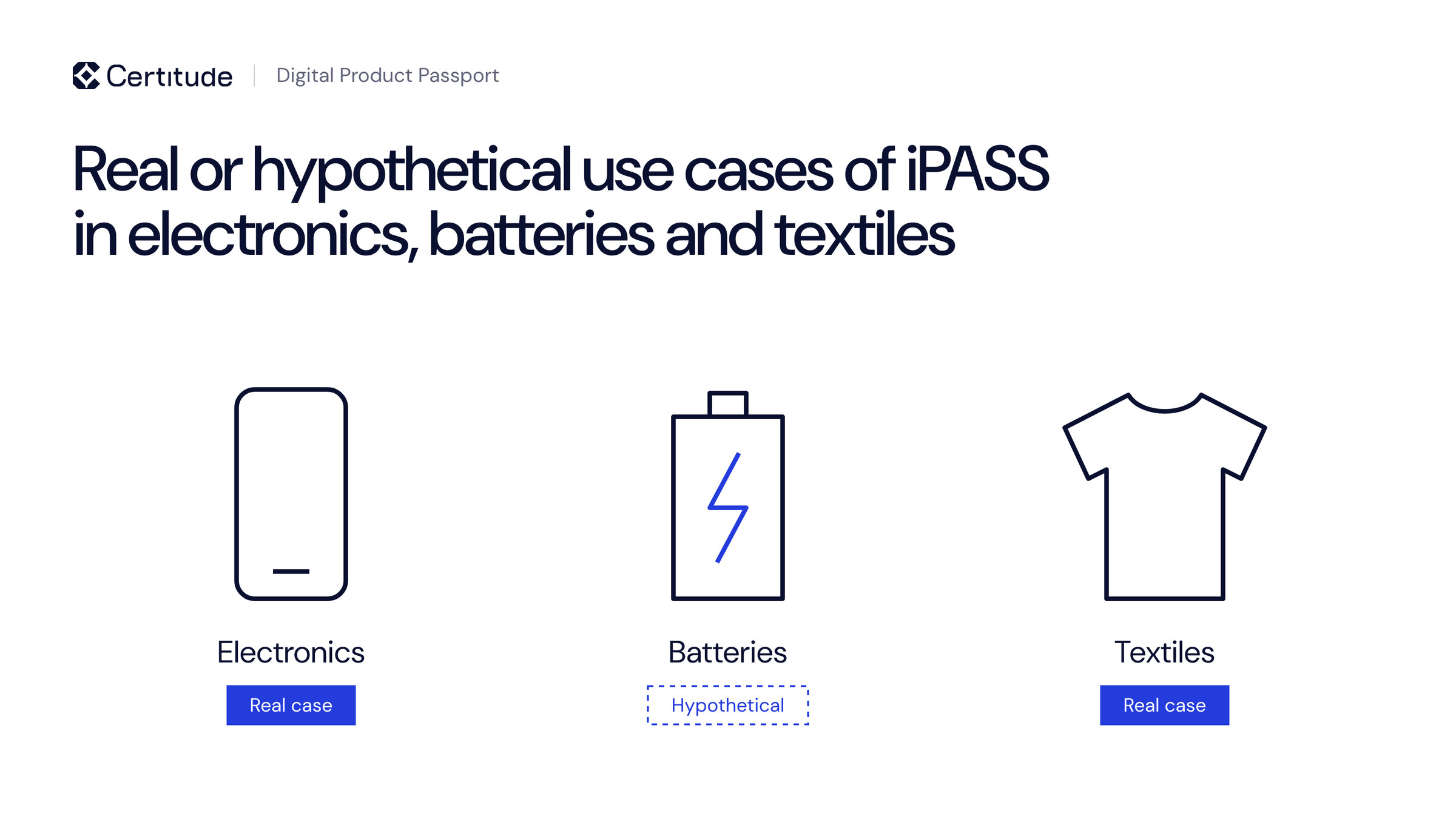
Textiles and footwear
A pair of pants manufactured in Bangladesh, distributed in Europe, and sold in Spain can have a digital history in iPASS:
- The producer issues a credential about the origin of the cotton.
- The manufacturer documents the manufacturing process.
- The distributor records transportation and storage.
- The retailer adds sales information and recycling options.
Result: the consumer can verify the complete traceability of the garment, from the field to the store.
Electronics
A smartphone assembled in Asia, with components from different continents, can include the following in its digital passport:
- The origin of the lithium or cobalt in the battery.
- The carbon footprint of its manufacturing process.
- The history of repairs and updates.
Result: the device not only complies with the DPP, but also offers the buyer confidence about its sustainability and origin.
Batteries
Industrial or electric vehicle batteries are one of the most critical cases. iPASS can document:
- The country of extraction of the raw materials.
- Safe transport certifications.
- The recycling and recovery of materials after their useful life.
Result: complete traceability that facilitates regulatory oversight and compliance with circularity objectives.
Benefits of iPASS in international supply chains
Adopting iPASS to implement the DPP in international contexts provides tangible benefits:
- Global trust: data is verifiable and accessible anywhere in the world.
- Fraud reduction: blockchain immutability makes counterfeiting or manipulation difficult.
- Regulatory compliance: companies comply with the DPP and other sustainability regulations.
- Competitive advantage: transparent brands gain preference in demanding markets.
- Comprehensive vision: each actor in the chain can consult and contribute information in real time.
Challenges of international traceability
However, the implementation of the DPP in global chains is not without difficulties:
- Data standardization: coordinating multiple actors with different formats.
- Integration costs: especially for SMEs in developing countries.
- Protection of sensitive information: balancing transparency and business confidentiality.
- Technical scalability: managing millions of products with digital passports.
How iPASS responds to these challenges
At iCommunity, we have designed iPASS so that the challenges of international chains become opportunities:
- Compatibility with global standards: W3C VC, DID Core, JSON-LD, OpenAPI 3.1.
- Accessible platform for SMEs and large companies, with adaptable costs.
- Granular data control, which allows you to decide what information is made public and what is kept private.
- Scalable infrastructure, capable of supporting millions of transactions without losing efficiency.
The role of consumers, regulators, and auditors
The value of international traceability does not only fall on companies:
- Consumers: they can verify with a scan whether a garment, a mobile phone, or a battery meets sustainability criteria.
- Regulators: they have real-time access to verifiable data, which facilitates cross-border audits.
- Auditors: they can digitally and reliably validate that each actor in the chain fulfills their part.
In this way, the DPP and iPASS convert a complex network into a transparent and reliable ecosystem.
Traceability in international supply chains is one of the greatest challenges of the global economy. With the Digital Product Passport, Europe seeks to transform this challenge into an opportunity to advance towards transparency, sustainability, and circularity.
With iPASS, from iCommunity we offer the digital infrastructure that makes this vision possible: unique identifiers, verifiable credentials, and immutable blockchain records that ensure that each product, regardless of its origin, has an authentic and accessible history.
The future of international trade will be fairer, more circular, and more reliable, and iPASS is the key to achieving it.