
The digitalization of the economy has brought a new need: trusting data. In a globalized world, where products go through increasingly long and complex supply chains, ensuring the authenticity of information has become a crucial challenge. In this context, the Digital Product Passport (DPP) emerges, a mechanism that seeks to offer transparency and complete traceability throughout the entire life cycle of a good.
At iCommunity, we are developing iPASS, a solution that uses Verifiable Credentials (VC) technology to respond to this challenge. Thanks to this approach, each product can have a reliable, immutable, and accessible digital history for all stakeholders.
In this article, we will explain what verifiable credentials are, why they are the basis of the DPP, and how iPASS uses them in each of the milestones of a product’s life cycle.
What are Verifiable Credentials?
Verifiable Credentials (VCs) are a standard of the World Wide Web Consortium (W3C) that allows the secure and reliable issuance, sharing, and verification of digital information. They function as the digital version of a physical document: an academic degree, a passport, a quality certificate, or an invoice.
The key is that these credentials are designed to be:
- Immutable: they cannot be falsified or manipulated.
- Portable: the holder can carry and share them at any time.
- Selectively revealable: the user can decide which part of the information they share and with whom.
- Interoperable: they adapt to global standards, allowing different systems to understand and verify them.
Applied to the world of products, VCs allow each milestone of their life cycle to be recorded in a secure and verifiable format.
iPASS: a VC-Based Digital Passport
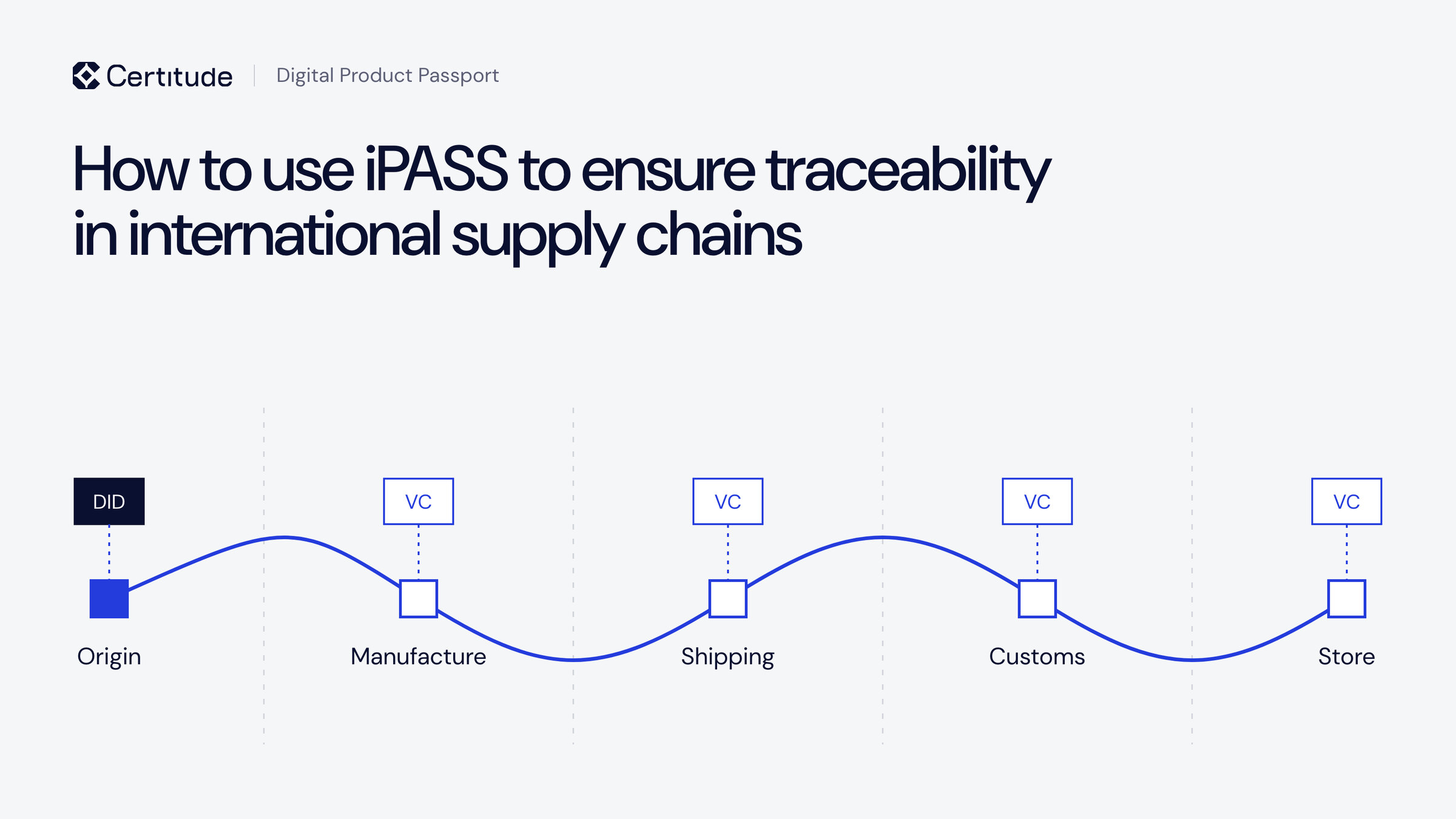
iPASS harnesses the power of VCs to bring the Digital Product Passport to life. Instead of relying on unverifiable declarations or fragmented databases, each product milestone becomes a verifiable digital credential issued by the responsible actor at that time: manufacturer, distributor, repairer, or recycler.
In this way, the product not only carries a history but also a set of verifiable proofs that guarantee its authenticity and reliability.
Product life cycle milestones and their registration in iPASS
The life cycle of a product does not end with the sale to the consumer: it begins with its design and production, goes through phases of use, maintenance, and repair, and ends with its recycling or disposal. Each of these stages can become a documented milestone within the DPP thanks to iPASS.
1. Design and manufacturing
In this phase, credentials are generated on:
- Origin of raw materials (e.g., organic cotton, recycled steel).
- Sustainability certifications (e.g., environmental ISOs).
- Production conditions (e.g., renewable energy in the process).
Example: A textile brand issues a VC that certifies that the fabric used in a garment comes from recycled fibers and with low water consumption.
2. Distribution and logistics
Transportation and storage are also part of the product’s impact. Credentials such as these are recorded here:
- Carbon footprint associated with transportation.
- Compliance with customs and health regulations.
- Storage conditions (e.g., controlled temperature).
Example: A battery manufacturer issues a VC indicating that the unit was transported in compliance with safety standards for hazardous materials.
3. Sale and use
At the time the product reaches the market, the credentials allow certifying:
- Manufacturer’s warranty.
- Verified instructions for use and maintenance.
- Proof of compliance with EU regulations.
Example: An electronic device incorporates into its DPP a VC that certifies the two-year warranty, issued directly by the manufacturer.
4. Repair and maintenance
The life cycle is extended when the product is repaired. Each intervention can be recorded in the form of a verifiable credential:
- History of repairs performed.
- Replacement of parts and origin of spare parts.
- Authorized workshops that issued the credential.
Example: An authorized workshop issues a VC indicating that the battery of an electric car was replaced with an original component.
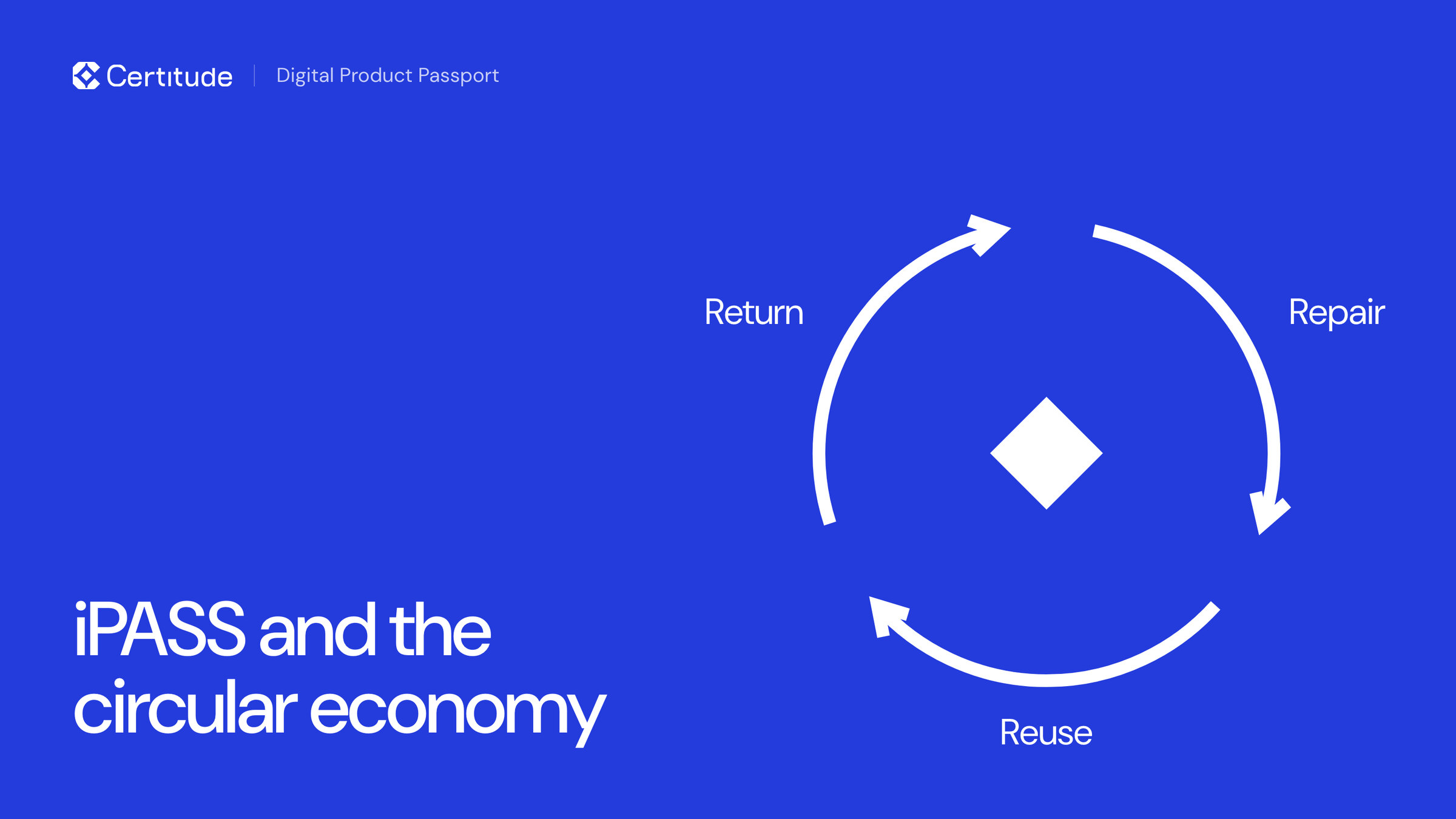
5. Reuse
Reuse is one of the great objectives of the DPP. With iPASS, each reused product can have credentials that validate its condition and residual value:
- Refurbishment certification.
- Validation that it meets quality standards for second life.
- Previous owner information, anonymized but verifiable.
Example: A reconditioned laptop receives a VC that certifies that it has passed performance tests and is ready for resale.
6. End of life and recycling
Finally, when the product reaches the end of its useful life, the DPP records credentials linked to its proper management:
- Recycling center that processed it.
- Recovered materials and percentage of recycling.
- Final destination of non-recoverable waste.
Example: A textile recycling plant issues a VC certifying that a T-shirt was broken down into reusable fibers.
Benefits of this approach
The use of VCs at each product milestone provides key advantages:
- Trust: each piece of data comes from a verifiable source.
- Transparency: the consumer has access to clear and complete information.
- Regulatory compliance: companies comply with the DPP and other European regulations.
- Efficiency: bureaucracy is reduced by digitizing and automating processes.
- Sustainability: reuse and recycling are facilitated, reducing waste.
In short, iPASS turns the product life cycle into a complete, verifiable, and accessible digital narrative.
Application in the priority sectors of the DPP
Although this model can be applied to any sector, the EU has defined four priority areas in which it will be mandatory from 2026. Let’s see how VCs work in each one:
- Textiles and footwear: certify sustainable fibers, responsible manufacturing processes, and recycling options.
- Electronics: record the origin of minerals, energy consumption, and repairs throughout the useful life.
- Batteries: issue credentials on raw materials, CO₂ emissions, and reuse capacity.
- Construction materials: document energy efficiency, emissions, and resources used.
In all cases, VCs allow creating a verifiable digital identity of the product, which accompanies it from its birth to its end of life.
Challenges and future
The adoption of VCs in the DPP is not without challenges:
- Establish common standards between sectors and countries.
- Digitize SMEs that still manage processes manually.
- Education of consumers and companies to understand and use the system.
- Global interoperability, beyond the EU.
Despite this, the future is promising. As standards mature and more actors join, the VC-based DPP will become an essential trust infrastructure for the digital economy.
The Digital Product Passport represents a paradigm shift in the way we manage information about the goods we consume. And at the heart of this system are Verifiable Credentials (VCs), which turn each life cycle milestone into a secure and reliable digital proof.
With iPASS, from iCommunity, we are demonstrating that the combination of VCs, blockchain, and interoperability is the key for the DPP to work in practice, bringing benefits to companies, consumers, and regulators.
Traceability, reuse, and responsible end-of-life management will no longer be abstract concepts: thanks to iPASS and verifiable credentials, they will become tangible realities that will transform the way we produce and consume.